Why Emilia-Romagna is the delicious antidote to overtourism in Italy
Did you know that the city of Venice receives around 30 million visitors per year? In peak season, roughly 80,000 people a day pack the narrow streets and small piazze of the city.

Meanwhile, in the quieter region of Emilia-Romagna, just to the south, it's a much calmer picture. Stretching from the Adriatic to the Apennine foothills, threaded by the old Via Emilia, it's Italy's larder, home to the likes of Parmigiano-Reggiano and balsamic vinegar, with a cultural heritage to match.
Getting there: find deals on specialist tours with HF Holidays*, which offers itineraries centred around food and hiking to help you really get to know the region at a gentle pace.
Ravenna
There were four of us in the Mausoleum of Galla Placidia in Ravenna. Every single centimetre of this UNESCO monument is decorated in delicate mosaic work dating back to the first half of the 5th century CE.
A cross at the peak of the dome descends through a starlit night sky into a scene of bright meadows, shepherds and, of course, Jesus. I feel gifted to be here almost alone, absorbing the spectacle; I take a moment to close my eyes and feel the weight of time.
Outside, a woman hangs washing from a first-floor window. A handful of visitors pause to photograph a doorway, then move on without breaking stride. Two teenagers drift past on bikes.
My guide, Rita, and I sit in the shade of an old sycamore tree and quietly chat about the deep history of the region. This is Ravenna at near-peak season, busy enough to feel alive, quiet enough to still feel like a city rather than a stage set. Fifteen minutes away, the Adriatic laps at long sandy beaches where sunbeds outnumber selfie sticks by a comfortable margin.
Ravenna sits just off one of the oldest roads in the world. Straight as a Roman intention, because that's exactly what it is, the Via Emilia has run through the heart of what is now Emilia-Romagna* since 187 BCE.
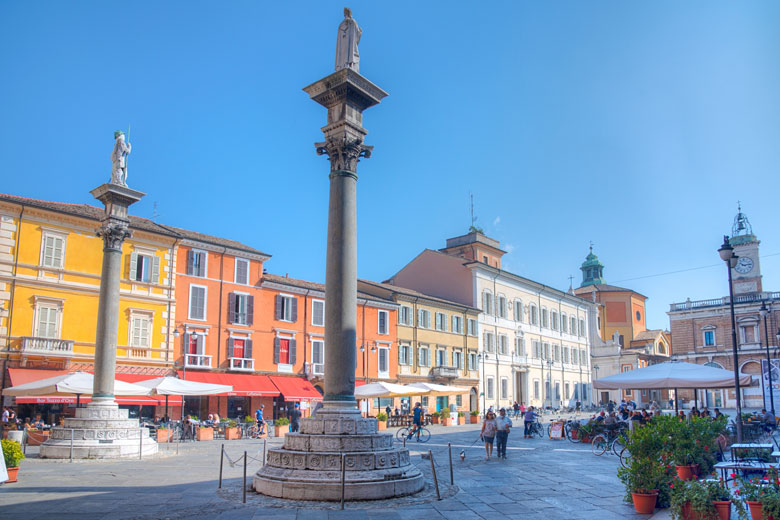
A railway now shadows almost every mile of it. Together they link a chain of cities containing enough history, food and culture to satisfy the most inquisitive traveller. This is not a hidden Italy*, exactly. It is simply one that the tourist trail forgot to turn left for.
Francesco is waiting outside a narrow doorway just off the Duomo di Modena, easy to miss if you didn't know it was there, a heavy old door, a window with a single barrel painted onto the glass, nothing else to mark it.
His family has been making vinegar in this part of the city for generations, and he talks about the barrels the way other people talk about relatives. Inside, heat in summer and cold in winter do the slow work that no factory can replicate; outside, you'd never know the room existed at all.
Aceto Balsamico Tradizionale di Modena DOP is aged for a minimum of 12 years, passing through a progression of barrels made from different woods: oak, cherry, chestnut, mulberry, juniper, each one smaller than the last, concentrating the must as the decades pass.
We taste our way along the shelf, six bottles in, the youngest sharp enough to make you blink, the oldest almost a syrup, tasting faintly of woodsmoke and Christmas cake. It is not just a condiment; it's an exercise in patience.
Parma
Parma arrives lighter on its feet. This is a city built for arcades and yellow stucco, for cyclists weaving past the Teatro Regio, for a long lunch eaten slowly because everyone else is doing the same thing.
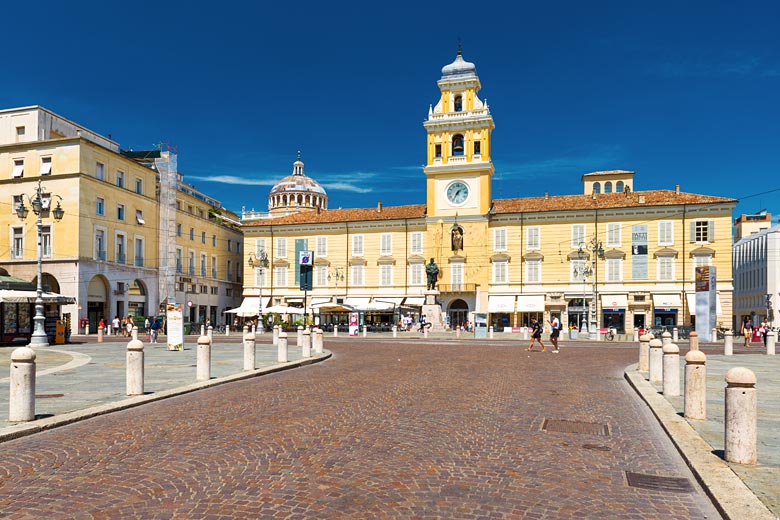
Verdi was born in the surrounding countryside, and Parma has never quite let him leave; his name turns up on theatres, festivals, café walls, as though Parma considers good taste a civic duty rather than an accident.
The ham and the cheese are still here, obviously, threaded through every menu and shop window, but they sit in the background rather than dominating the foreground; it's a city snacking happily on its own legend rather than performing it for visitors.
A morning trip out to a curing house or a Parmigiano dairy is easy to arrange and worth the detour, but Parma itself doesn't need the excuse. It would be a pleasant place to get gently, harmlessly lost, regardless of what was on the menu.
Bologna
Bologna sits at the centre of all of this, geographically and gastronomically. 'La Grassa', 'the fat one', is its oldest nickname, and it remains the most honest. The porticoed streets run for miles under cover, the markets at Quadrilatero spill out across the medieval grid, and the food is ferociously, unapologetically good.
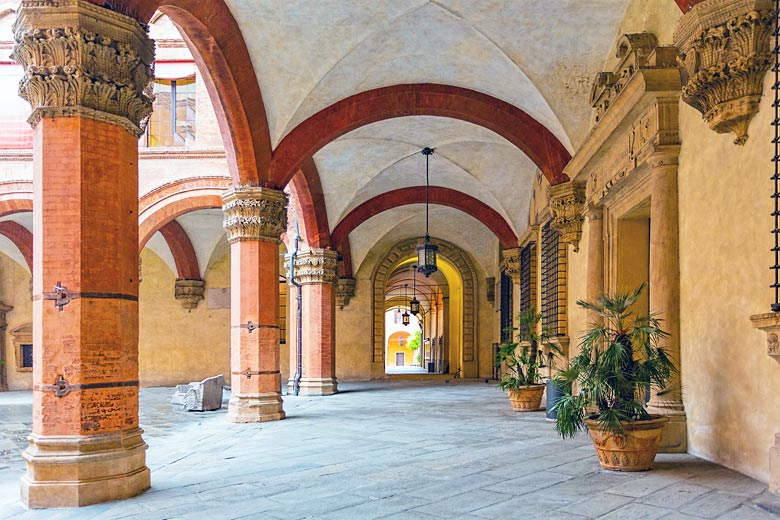
It is also home to the oldest continuously operating university in the Western world, founded in 1088. In summer, Piazza Maggiore becomes Europe's largest open-air cinema, and for me, one of the joys of Bologna is sitting shoulder to shoulder with locals and visitors on the cobbles, watching old films under the stars.
Bologna is busier than the rest of this route, but set beside Florence, Rome or Venice, it sees far fewer people. Eat here, sleep here, use it as a base. The entire Via Emilia is within an hour by train in either direction.
Ferrara
Thirty minutes north of Bologna, Ferrara breaks the pattern entirely. Where most Italian cities grew organically over centuries of narrow lanes and accidental piazzas, Ferrara was planned.
In the late 15th century, Duke Ercole I d'Este redesigned the city on his own terms: wide, straight streets, a coherent grid, and an entire quarter built to a Renaissance idea of what a city should look like.
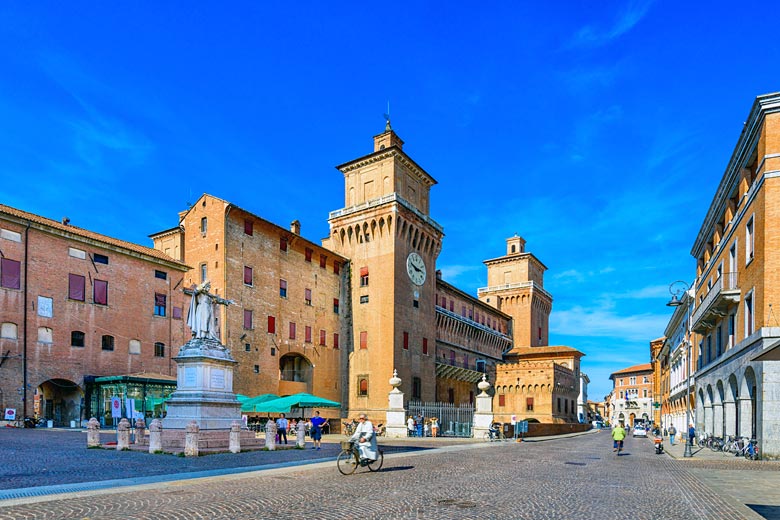
The result still feels faintly utopian, flat, almost entirely car-free, and best explored by bike, including along nine kilometres of intact city walls. The Castello Estense sits at the centre of it, moat and all, having housed one of the most cultured courts in Renaissance Italy.
Ferrara is the rare UNESCO city that earns its listing for an idea rather than a single monument, a reminder that the Via Emilia is only the spine of the thing, and that the branch lines peeling off it are where this region starts to feel like your own discovery rather than someone else's itinerary.
Rimini
The road ends at Rimini, where the Adriatic finally appears. Sunbeds, nightclubs and package tourism dominate the postcards, and that reputation isn't entirely undeserved. But at the centre of the resort sprawl sits a Roman city of genuine weight.
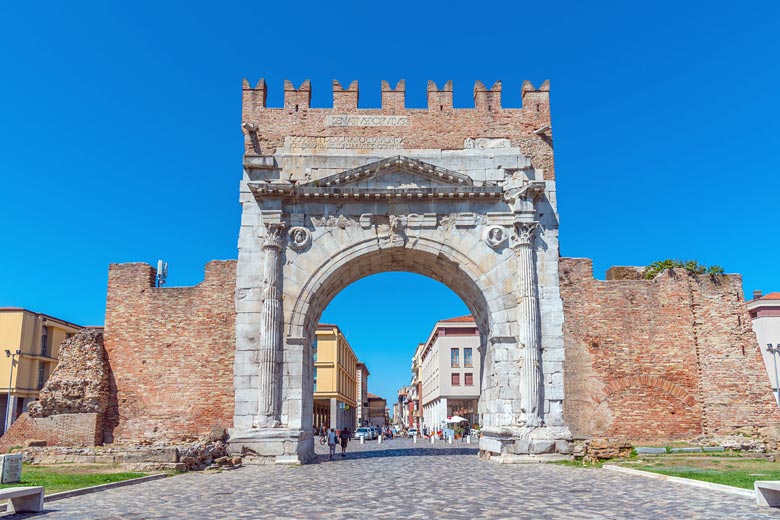
The Arch of Augustus, built in 27 BCE, still stands at the point where the Via Emilia meets the Via Flaminia. In Piazza Ferrari, I stop mid-step and realise I'm standing on glass, beneath my feet, a Roman surgeon's mosaic floor, undisturbed for two thousand years, only rediscovered in 1989. The beach is real. The Roman heart underneath it is simply waiting for the crowds to look down.
The train back runs the line the road has always followed, with fields, vineyards, a ridge of the Apennines to the south. A few metres beneath the tracks, the original Roman stones are, perhaps, still there.
The journey hasn't changed. Neither, if the food is anything to go by, has much else. Venice will still be there next year, as crowded as ever. This road will too, just considerably quieter.
Climate in Emilia-Romagna
| Jan | Feb | Mar | Apr | May | Jun | Jul | Aug | Sep | Oct | Nov | Dec | |
|---|---|---|---|---|---|---|---|---|---|---|---|---|
| Maximum daytime temperature °C |  7 7 |
 9 9 |
 13 13 |
 17 17 |
 21 21 |
 25 25 |
 28 28 |
28 |
24 |
19 |
13 |
8 |
| Hours of sunshine (daily) | ||||||||||||
| Days with some rainfall |  12 12 |
11 |
12 |
 13 13 |
12 |
11 |
 8 8 |
9 |
9 |
11 |
13 |
12 |
| Sea temperature °C |  11 11 |
10 |
10 |
 13 13 |
 18 18 |
 22 22 |
 25 25 |
 26 26 |
23 |
19 |
 16 16 |
13 |








The above guide shows the climate in Rimini. Find out more about conditions across the country in our complete guide to the climate in Italy.
Ready to discover Italy? Don't miss the latest online offers on tours from HF Holidays.
More about Rimini





Rimini by month
Jan Feb Mar Apr May Jun Jul Aug Sep Oct Nov Dec
Explore holiday destinations
- Beach holidays
- City breaks
- Family holidays
- Half term holidays
- Spring holidays
- Summer holidays
- Autumn holidays
- Winter sun holidays
- Honeymoons
- Coolcations
- Compare places
- Ski resorts
Save with latest deals & discounts
- Holiday offers
- Top travel brands
- Airlines & flights
- Discount hotels
- TUI
- Jet2holidays
- Neilson
- Marella Cruises
- Holiday Extras
- Pierre & Vacances
- Caledonian Travel
- Club Med
Airport parking
- Manchester Airport
- Stansted Airport
- Bristol Airport
- Luton Airport
- Birmingham Airport
- Edinburgh Airport
- Gatwick Airport
- Glasgow Airport
- Newcastle Airport
Airport lounges
- Manchester Airport
- Birmingham Airport
- Bristol Airport
- Edinburgh Airport
- Glasgow Airport
- Heathrow Airport
- Newcastle Airport
- Stansted Airport
- Gatwick Airport
Be inspired
Get your weekly fix of holiday inspiration from some of the world's best travel writers plus save on your next trip with the latest exclusive offers
We promise not to share your details