

Best places to see the Northern Lights

A trip to see the Northern Lights is, for many, one of those dreamy once-in-a-lifetime experiences. The dark, cold nights and snow-covered, often dramatic landscapes of northern regions in the depths of winter, where the chances of seeing these lights glow bright overhead are higher, ensure it.
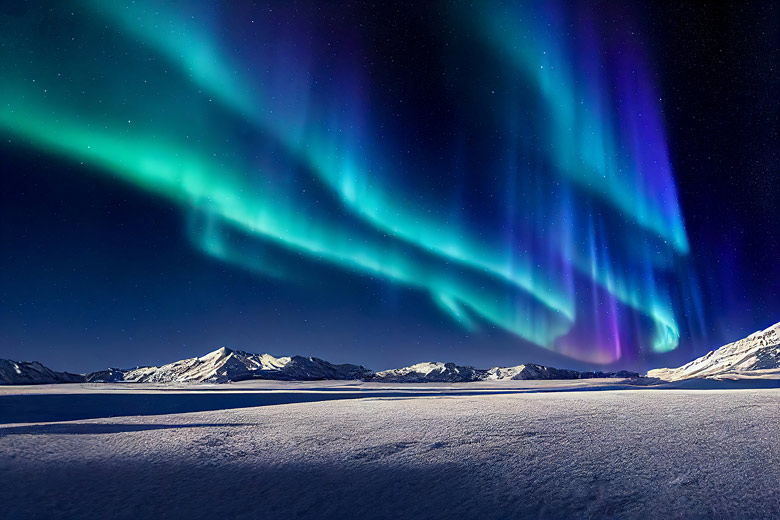
However, the reality of chasing the Northern Lights is that so much of the success rate depends on the coming together of various elements, including a little bit of luck. Here, we unpick the science behind the Aurora Borealis and consider where in the northern hemisphere offers you the best chance of spying this most transfixing of natural phenomena.
- Summary: Northern Lights at a glance
- What are the Northern Lights?
- Understanding the science
- Is there a Northern Lights forecast?
- Where & when to see the Northern Lights
- Top 10 places to visit
- Why book a Northern Lights cruise?
- Where to book tours & holidays
- How to capture the Northern Lights
- Top tips for viewing
Summary: Northern Lights at a glance
- typically, you need to travel near or within the Arctic Circle to see the Northern Lights
- they're most active during the solar maximum
- faint to the naked eye, cameras capture the Northern Lights as much brighter
- darkness is required, which makes autumn & winter the best time
- clear skies & low light pollution also increase chances of seeing them
- you're most likely to see them when outdoors, so warmth is a consideration
- today, there are moderately accurate aurora forecasts to help plan sightings
What's the difference between the Northern Lights & the Aurora Borealis? Essentially, Northern Lights is the everyday, less scientific term for the Latin-derived Aurora Borealis, specifically in the northern hemisphere. In the southern hemisphere, the Southern Lights are known as the Aurora Australis.
What are the Northern Lights?
The Northern Lights, also known as the Aurora Borealis, normally occur in narrow areas called the Auroral Zone that surround the Earth's geomagnetic north and south poles.
They happen when charged particles from the Sun, guided along the Earth's magnetic field lines, collide with gas molecules in the upper atmosphere, causing them to glow.
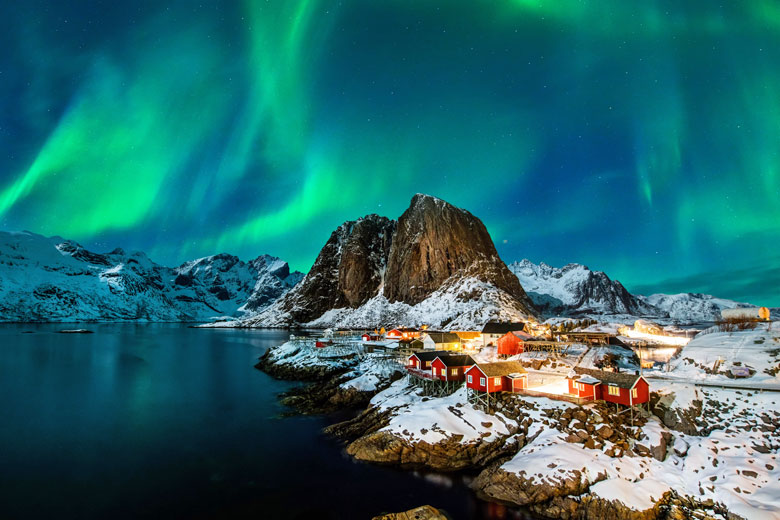
This is what we see as the aurora: curtains of mostly green light that appear to hang in the night sky, which slowly fold and unfold, glowing brighter at times and then fading. They normally occur between 100 km and 300 km above the Earth's surface.
Did you know? The solar maximum occurs every 11 years. The last solar maximum was in October 2024, and good auroras are expected throughout 2026. The next solar maximum is due sometime in the mid 2030s.
As for the colours, the green lights are caused by particles interacting with oxygen atoms, while blue and purple lights come from interactions with nitrogen atoms. Then there are rarer red lights that appear when particles mix with oxygen that is much higher in the earth's atmosphere.
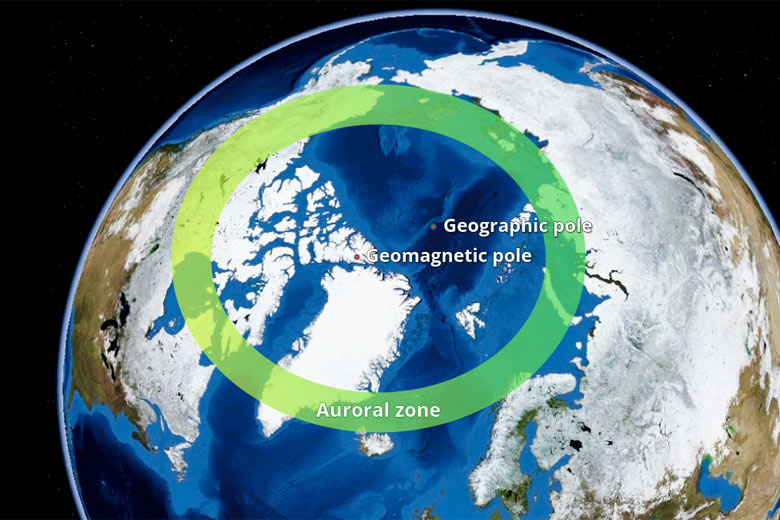
The charged particles from the sun, also known as the solar wind, are variable streams of electrons and protons, which largely determine the magnitude of the auroral displays. The solar wind is strongest when the surface of the Sun is at its most active. This is known as the solar maximum.
There is a natural cycle to the solar wind, so it is, to some extent, predictable. At times, when it is most turbulent, auroras become visible at lower latitudes than normal, too.
This is when it can be worth travelling to see them. Not only are auroras more spectacular, but they also become visible over a much wider area. The Auroral Zone expands towards the equator, sometimes doubling or tripling in extent, which, in the case of the Northern Lights, makes them visible over more populated areas of northern Europe and North America.
By contrast, when the solar wind is weak, the Northern Lights are not only limited in their extent but also less bright and colourful.
However, the Sun is rarely quiet, and even during the solar minimum, the period when the Sun is least active, solar storms can occur, so there is still a chance to see them, although you will likely have to travel further north to find them.
Understanding the science behind the Northern Lights
The Sun leads a turbulent life because it rotates faster at the equator than at the poles. Over time, this difference causes the Sun's magnetic fields to become twisted and tangled. As a result, sunspot activity on the surface increases, and eventually the Sun's magnetic poles reverse their polarity.
All of this happens over about 11 years, in a pattern called the solar cycle, and the middle of this cycle is known as solar maximum, which we've touched on above.
According to NASA, the Sun reached solar maximum in the current cycle in October 2024, and the next one is expected around 2035. However, auroras are still expected to be good until at least the end of 2026, and it is always possible to see them even when the Sun is less active.
During solar maximum, the twisted magnetic fields around sunspots often release huge bursts of energy and material into space. These events, called solar flares and coronal mass ejections, are when the Northern Lights can be at their brightest and most active.
Cruise to the Northern Lights: browse and book an affordable and more intimate cruise to see the Northern Lights with Fred Olsen*.
Is there a forecast for the Northern Lights?
Forecasting the aurora is not exactly straightforward, but interpreting what's known as space weather (literally conditions in space) indicates when there will be increased activity that would likely lead to a visible aurora.
National space agencies worldwide work together to produce these space weather forecasts that feed into websites and apps that help people who are hoping to see the aurora. Two of the most popular apps regarding the current state of the aurora are:
- My Aurora Forecast & Alerts (Google Play / Apple Store)
- Hello Aurora
Alternatively, visit the following websites for more aurora forecasts and background information:
- SpaceWeatherLive.com
- SolarHam.com
- spaceweather.gov - US Government
- Space Weather Service - European Space Agency
From the point of view of aurora-watchers, these forecasts can predict geomagnetic storms, solar wind speeds and aurora visibility, often up to three days in advance. The key metrics in the space weather forecast are:
Kp-Index
The Kp-Index indicates global geomagnetic disturbances on a scale of 0 to 9. Selectively placed magnetometers (devices for measuring magnetic fields) help to calculate the score, which translates as follows:
| Kp index | Interpretation | Description |
|---|---|---|
| 0-2 | low | Auroras will be weak & usually only be visible within the Auroral Zone. |
| 3-4 | medium | Auroras will be brighter & more active, but still mostly at high latitudes. |
| 5-6 | high | The Auroral Zone expands to lower latitudes, making auroras visible further south. |
| 7-9 | very high | Auroras can be seen at unusually low latitudes; they will generally be more active with more intense colours. |
The biggest problem with the Kp-Index is that it is a global average, so it cannot tell you what is happening locally with the Earth's geomagnetic field. It also only measures magnetic disturbance, not auroral brightness and is only calculated every three hours, while auroras can change in minutes. That said, it is a good indicator of aurora potential.
Solar wind speed/density
The speed of the solar wind is an important metric in space weather forecasts. Solar wind typically travels at around 400 kilometres per second (kps) when it hits the Earth's magnetic field, but when solar activity is high, speeds can rise to 800 kps, and even 1000 kps.
These high speeds transfer more energy to Earth's magnetosphere (a sort of magnetic bubble around Earth that deflects and traps charged particles), thereby increasing the potential for brighter or better auroras. When reading space weather reports, look for higher-than-normal solar wind speeds.
Solar wind density is another factor to watch. The density tells you how many particles there are in the upper atmosphere. A concentration of up to five particles/cm3 is normal.
When more plasma is released from the Sun, the density increases, further distorting Earth's geomagnetic field. A figure of 20 particles/cm3 is considered high and therefore likely to increase the potential for brighter auroras.
Bz/IMF
It's easy to get lost in the acronyms and lettering, but stick with us as we break this one down.
'IMF' stands for the 'interplanetary magnetic field' carried from the Sun by the solar wind, while 'Bz' indicates the north-to-south component of the IMF. Think of bar magnets in the classroom, where children discover that like fields repel while opposite fields attract. Similarly, in space, positive charges repel each other, while positive charges attract negative charges.
So if the Bz figure is negative, it means there is a stronger coupling between the two magnetic fields so that more particles can find their way down towards Earth's geomagnetic poles producing stronger auroras. On the other hand, if Bz is positive, the Earth's magnetic field tends to block some of that energy leading to weaker auroras.
Assuming the prospects for viewing the aurora are good in your chosen location there is generally a 'best time' for the displays during any particular night. As the Earth rotates, your location gradually becomes more directly in line with the solar wind blowing over the geomagnetic pole.
This is where geomagnetic forces are at their maximum, stretching the auroral zone towards the equator. The time this occurs is known as 'geomagnetic midnight', and it generally produces the best auroras of the night. On NASA's aurora forecast, it can be seen as a bulge in the auroral zone under which the Earth rotates.
Where & when to see the Northern Lights
A trip to see the Northern Lights is the stuff of dreams for many travellers. Yet, even if you travel somewhere within or close to the Auroral Zone, it's all about timing and still requires a little bit of luck.
Destinations that fall under the Auroral Zone are definitely good options to start with. Add in going in winter, or at least when there are hours of total darkness, and your chances improve. Light pollution also poses problems, so a remote location is an additional benefit. Unsurprisingly, therefore, the best locations to see the Northern Lights are already fairly remote, which is good for viewing but can make getting there a little inconvenient.
The good news is that a whole industry has grown up in the main centres for aurora watching, providing local knowledge and Northern Lights tours, and in some locations specialist hotels featuring heated cabins with glass roofs and observatories for comfortable viewing. It's worth noting, however, that to really see the aurora, you will have to stand outside, often in the cold!
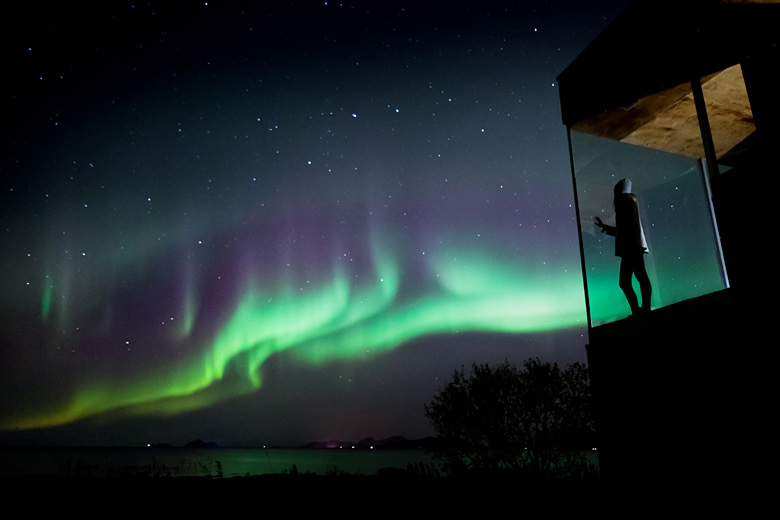
One problem that is common when viewing natural events is the weather, and since the aurora is typically only visible in sub-arctic regions during the cooler months, weather becomes a major consideration.
In Europe, many of the places under the Auroral Zone are on or near the Atlantic Ocean, which is notoriously cloudy in winter. Heading somewhere with dramatic scenery, like the Lofoten Islands in Norway, can be riskier for Northern Lights viewing than going to Alta or Kirkenes on the Norwegian mainland, which are less affected by Atlantic weather.
Unfortunately, nowhere can (or should) guarantee the perfect aurora. If you can, stick around for a few days to allow any bad weather to pass and be flexible with your plans, so you can move to a better location at short notice, although this is not always easy in dark sub-zero conditions.
Here, we look at some of the best places renowned for seeing spectacular displays of the Northern Lights across Europe and North America.
Norway
Norway is renowned for its Northern Lights thanks to its location within the Arctic Circle; places like Tromsø, the Lofoten Islands and Alta offer frequent sightings, minimal light pollution and easy access. However, while Norway is a great place to see the aurora, cloud cover from the Atlantic can reduce visibility in destinations close to the coast.
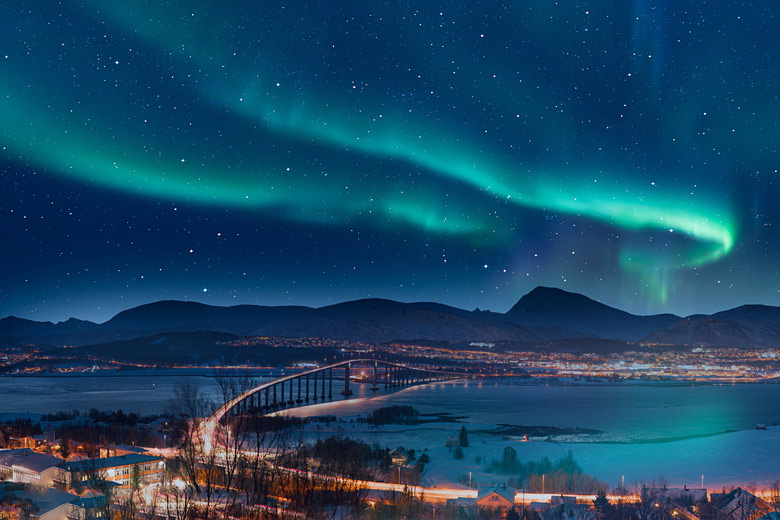
Tromsø
- lies within the Auroral Zone, giving it a high probability of aurora displays
- combines relatively good accessibility with options to join a tour to darker areas nearby
- offers a mix of convenience & good aurora potential
- infrastructure includes night tours, lodgings and other winter activities
- great for first timers & those after comfort with decent odds of a sighting
Alta
- known for its generally stable, inland weather & clearer skies
- fewer crowds, more peaceful viewing experience
- best for those after clear skies, willing to trade convenience for success
Lofoten Islands
- one of the most photogenic aurora backdrops in the world
- offers a good number of aurora sightings
- geography makes weather conditions variable
- cloudier than the mainland, so the aurora is not always visible
- good for patient photographers & travellers after scenery & aurora despite cloud potential
Lyngen Fjord & Alps
- 50 kilometres east of Tromso
- fjords, mountains & inland can mean less cloud
- alternative options to the south to escape Atlantic weather
Kirkenes
- place with very high aurora activity
- located in the far northeast of Norway
- situated a little inland & more sheltered than western coastal areas
- plenty of accommodation options
Svalbard
- often cited as an option but probably too far north
- extremely high latitude makes it difficult & expensive to get to
Sweden
Sweden is arguably one of the most accessible places in Europe to head for a spot of aurora watching. Northern regions like Abisko, Kiruna and Swedish Lapland offer clear skies, low light pollution and good infrastructure. What's more, you don't need to be an expert to see them. Weather permitting, Northern Sweden makes seeing the Northern Lights achievable.
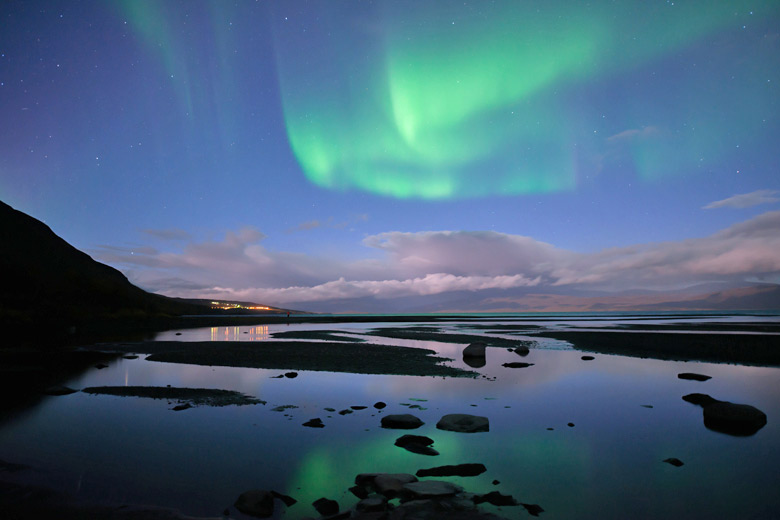
Abisko National Park
- widely considered to be the best place in Sweden
- accessible via good rail connections
- home to the famous "Blue Hole", which creates perfect viewing conditions
- site of Aurora Sky Station on Mount Nuolja
Kiruna & Jukkasjärvi
- located in Sweden's northernmost municipality
- easily accessible via the airport with good rail connections
- ample aurora tours, snow hotels & wilderness lodges
- near Sweden's famous Icehotel
- not as clear as Abisko but still excellent & more convenient
Finland
Finland is generally a good option for viewing the Northern Lights as it's typically less cloudy than places in countries bordering the Atlantic.
However, northern Finland is only on the edge of the Aurora Zone, while in Greenland, Canada, and Alaska, for example, some places are more directly under it. That said, when the Sun is very active, northern Finland can be excellent.
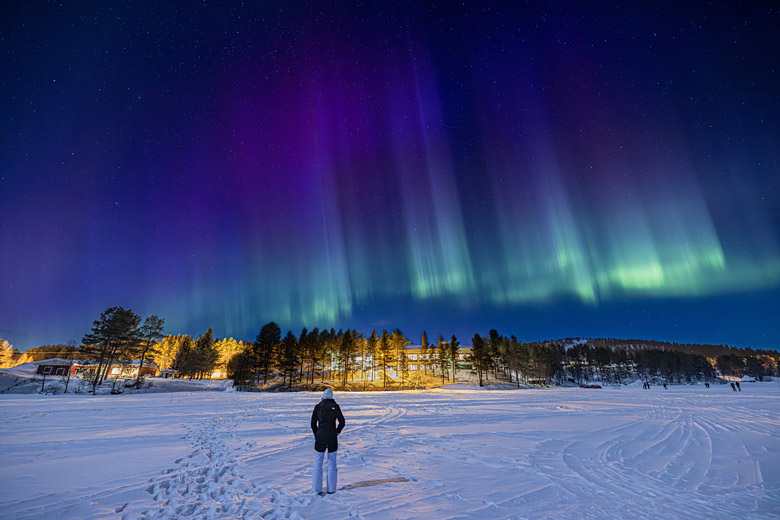
Kilpisjärvi
- one of Finland's highest aurora visibility rates - top choice
- close to the border between Finland, Norway & Sweden
- extremely dark skies with minimal light pollution
Utsjoki
- Finland's northernmost municipality
- very sparse population
- very dark skies
Inari (Ivalo)
- remote location but accessible from Ivalo Airport
- large Lake Inari gives wide-open horizons
- perfect for viewing & photography
Saariselkä
- popular Lapland resort area
- good tourist infrastructure
- glass cabins & igloos plus guided tours available
Rovaniemi
- easy to reach via major airport & good rail connections
- more light pollution than the far north
- great if you want a balance of comfort & aurora viewing
- possibly a bit too far south, except when the Sun is very active
Iceland
Iceland offers a tasty mix of dramatic landscapes and strong aurora activity, making it one of the most popular destinations for seeing the phenomenon. Located near the Arctic Circle, Iceland hosts frequent aurora sightings on clear nights away from city lights.
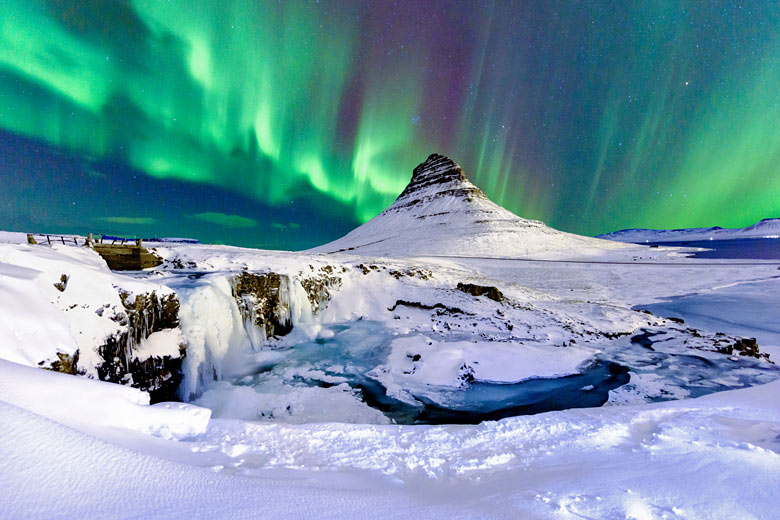
While weather and cloud cover can be unpredictable, Iceland's accessibility and variety of viewing spots make it an exciting choice for aurora hunters. Generally speaking, places in the north and northeast are typically clearer than the south and west.
Thingvellir National Park
- top choice near Reykjavík
- only 45 minutes from the capital, but extremely dark & open
- good for photographers, thanks to wide plains & lack of light pollution
- offers great viewing without travelling off-grid
Snaefellsnes Peninsula
- nicknamed "Iceland in Miniature" for its diverse landscapes
- very low light pollution, wide coastal areas & dramatic mountains
- good weather balance thanks to mixed coastal & inland terrain
Vik & the south coast
- long stretches of dark, open coastline
- iconic backdrops like Reynisfjara Beach & Dyrhólaey
- weather can be variable, but spectacular when clear
Lake Myvatn
- known for more stable winter weather than the south
- far from major cities with extremely dark skies
- located away from the coast
Akureyri & Eyjafjörður
- northerly with good infrastructure
- Eyjafjörður is the longest fjord in Iceland
- short drive outside of Akureyri yields excellent dark-sky conditions
- good option for comfort plus high aurora chances
Westfjords
- most remote, darkest skies, but quite exposed to Atlantic weather
- minimal light pollution & dramatic fjords
- Very quiet, perfect for deep-sky viewing when clear
- Best for experienced winter travellers; roads can be challenging in winter
Greenland
Greenland is one of the world's most dramatic and rewarding places to watch the Northern Lights, thanks to its location deep within the Arctic Circle and the Auroral Zone. It promises very low light pollution across vast areas of snowy wilderness, yet within reach of facilities.
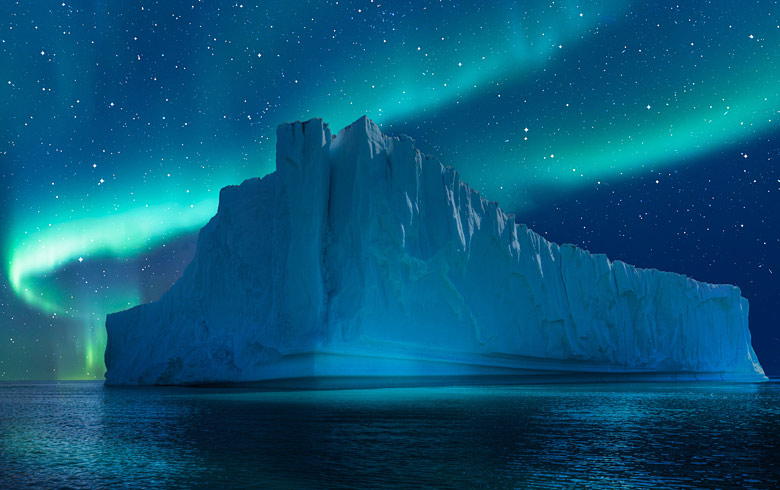
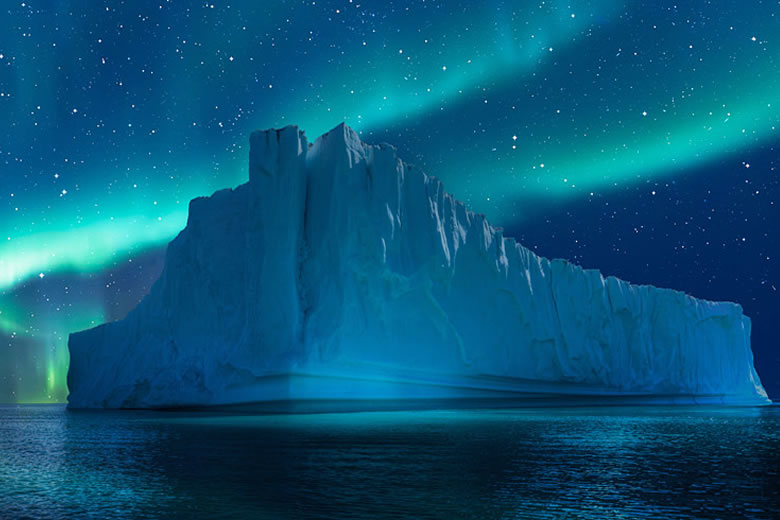
From autumn to spring, Greenland sees long dark nights and generally clear skies, which create excellent conditions for aurora sightings. Viewings are made extra special by the coast when you throw in the icebergs shimmering below.
Kangerlussuaq
- western Greenland is widely considered to be the best area
- stable weather: inland, dry, less cloud cover
- high aurora frequency from late August to early April
- easy to reach by domestic flight from Nuuk or Ilulissat
- minimal light pollution
- excellent for first-time aurora travellers & photographers
Sisimiut
- good combo of access, nightlife & some clear skies
- larger town with amenities, tours & activities
- coastal but still has relatively good weather
- great for combining with an active holiday
Ilulissat
- dreamy combo of auroras & icebergs
- 400 km inside the Arctic Circle at the northern edge of the Aurora Zone
- UNESCO Icefjord with giant icebergs
- plenty of tourist infrastructure
- cloudier than Kangerlussuaq, but still decent winter viewing
Nuuk
- easy urban access, good winter auroras
- capital & largest town in Greenland, with many tour operators
- can see excellent auroras on clear nights
- coastal location can mean it's cloudy
Qaanaaq / Thule
- long dark, polar nights & very low light pollution
- very remote & expensive to reach
- arguably too far north
- weather can be harsh & aurora seen low in the southern sky
- one for extreme-adventure travellers & photographers
Canada
Canada is one of the easiest places in the world to see the Northern Lights, because the geomagnetic North Pole sits within its borders.
This means you don't have to travel as far north as in other countries to catch the aurora, and regions like Yukon, Northwest Territories and northern Alberta offer dark skies, reliable aurora activity, and stunning wilderness backdrops for an unforgettable light show.
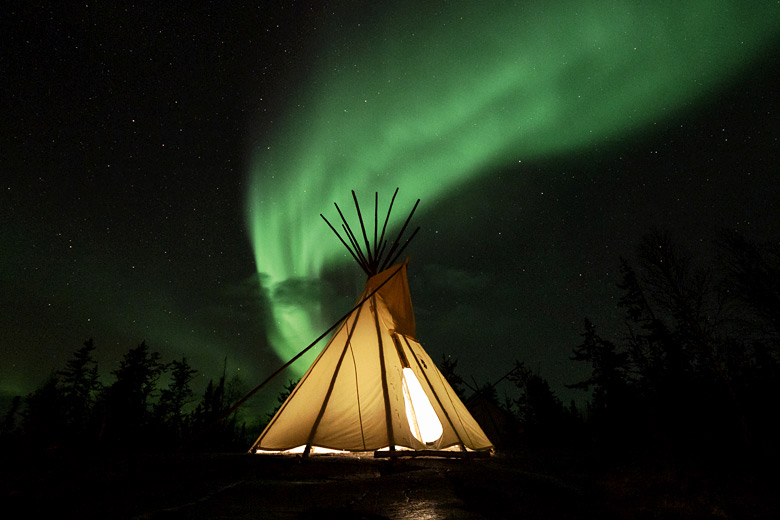
Yellowknife, Northwest Territories
- best overall destination in the world
- one of the world's highest aurora probabilities
- more than 200 nights per year with sightings
- stable subarctic climate with lots of clear skies
- many aurora tour operators, cabins, viewing domes & photography guides
- accessible from major Canadian cities
- September, February & March offer the clearest skies
- best for guaranteed results
Whitehorse, Yukon
- mix of wilderness & accessibility
- reliable aurora during winter & early spring.
- beautiful mountains & forests for photography.
- lots of winter activities available
- scenic, good viewing potential without going too remote
Churchill, Manitoba
- Northern Lights with a side of polar bears in autumn
- clear winter skies, especially in February & March
- wild tundra views & landscapes
- top option for wildlife & auroras in one trip
Fort McMurray, Alberta
- high aurora frequency for its latitude
- accessible & very affordable compared with the far north
- good weather windows in winter
- arguably a little too far south of the Auroral Zone
- budget-friendly option
Northern Saskatchewan / Athabasca Sand Dunes Region
- very dark skies with almost no light pollution
- amazing photo locations with lakes, boreal forest & dunes
- fantastic for photographers
Iqaluit & Baffin Island, Nunavut
- remote, pure Arctic wilderness but probably too far north
- expensive to reach & weather can be challenging
- offers extreme Arctic landscapes & cultural experiences
Northern Quebec (Nunavik)
- very high aurora activity & great winter skies
- Inuit communities with cultural trips
- memorable off-the-beaten-path aurora tourism
USA
In the United States, the Northern Lights are most reliably visible in Alaska, where long, dark winter nights provide ideal conditions for the aurora. Areas around Fairbanks and the Arctic Circle offer some of the best opportunities, with clear skies and minimal light pollution.
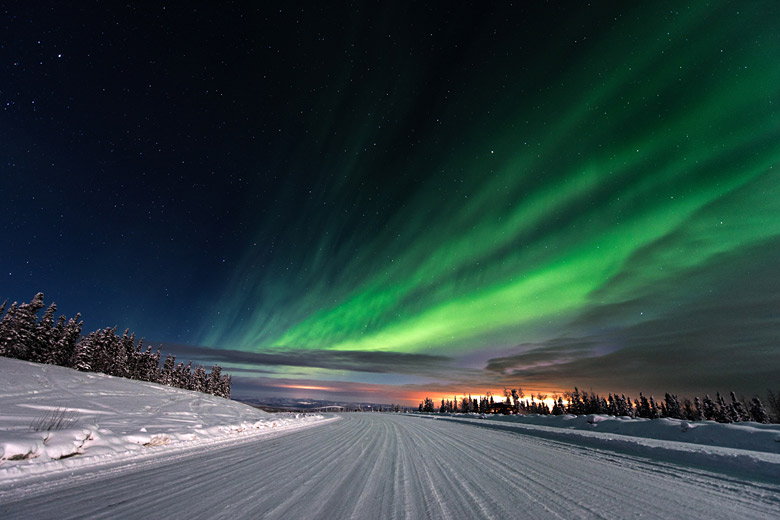
Fairbanks, Alaska
- 170 km outside the Arctic Circle
- often good conditions with relatively stable weather
- inland climate means clearer skies
- good viewing locations nearby, including Cleary Summit, Murphy Dome
- decent infrastructure, including lodges
- in-town hot springs resort specially equipped for aurora viewing
Coldfoot, Alaska
- 300 km north of Fairbanks, inside the Arctic Circle
- good for the maximum chance of seeing Northern Lights
- dark skies, but very cold
- accessible via the nearby airport
Anaktuvuk Pass, Alaska
- 400 km north of Fairbanks inside the Arctic Circle
- similar to Coldfoot but more remote
- good chance of seeing Northern Lights
- dark skies, but very cold
- accessible via the nearby airport
Other destinations
Of course, you may well spy the Northern Lights in other, more southerly, destinations, including the northern islands of Shetland and Orkney in Scotland, as well as, on rare occasions, across the wider UK. However, this happens far less frequently and is more of a special treat than something that can be relied upon for avid aurora watchers.
We've also omitted the Faroe Islands from our collection because this archipelago in the North Atlantic, as well as being a little too far south, has a wild weather system that brings a great deal of cloud.
Top 10 best places to see the Northern Lights
By now, you understand that achieving a clear sighting of the Northern Lights is not an exact science. However, taking all of the factors into consideration, we have been able to compile a list of the top 10 places in the northern hemisphere where you're most likely to see the Aurora Borealis. Find out more below.
| Place | Why visit? | |
|---|---|---|
| 1 | Yellowknife Northwest Territories, Canada |
Clearer winter skies than other places listed with direct flights from major airports in Canada. |
| 2 | Fairbanks Alaska, USA |
A close second place with clear skies & direct flights from the rest of the USA. |
| 3 | Abisko National Park Sweden |
Probably the best place in Europe; however, there are limited flight connections, so the train is the best option. |
| 4 | Tromsø Norway |
Most accessible place in Europe with direct flights from over 20 European cities. |
| 5 | Whitehorse Yukon, Canada |
More extensive tourism infrastructure than Yellowknife, but not quite so reliably clear. |
| 6 | Kangerlussuaq Greenland |
High number of sightings & less affected by weather from the ocean owing to its inland location. |
| 7 | Akureyri & Eyjafjörður Iceland |
More clear sky nights in northern Iceland than in the west or the south coast. |
| 8 | Inari (Ivalo) Finland |
Not the most northerly location in Finland, but it has good flight connections & local tourism infrastructure. |
| 9 | Lofoten Islands Norway |
Popular with photographers & cruise ships thanks to the dramatic scenery but prone to Atlantic weather. |
| 10 | Rovaniemi Lapland, Finland |
Well-developed tourist destination, but maybe too far south unless it's a good year for the Northern Lights. |
Why cruises are a good way to see the Northern Lights
Taking a cruise to see the Northern Lights is one of the most popular ways to see the Northern Lights. Several big-name cruise companies offer dedicated itineraries departing from British and Norwegian ports, as well as from the Netherlands and Iceland.
Although a cruise ship cannot totally avoid Atlantic weather, it can move relatively quickly to find clearer conditions if the weather is cloudy, and you always have the warmth of the ship's interior, from where you can view the aurora if you do not wish to venture on deck.
The big advantage of seeing the Northern Lights from a cruise ship is that you don't have to worry about finding the right spots for viewing. Experts will take care of this for you by monitoring the Earth and space weather reports.
The following companies offer Northern Lights cruises:
- Fred Olsen Cruises*
- Holland America*
- Hurtigruten Expeditions*
- Hurtigruten Norway*
- Ambassador Cruise Line*
Where to book land-based tours & holidays
The following tour operators offer small group tours or self-guided itineraries to see the Northern Lights across different regions. If you want to visit an off-the-beaten-track destination, you might need to book your trip in separate elements or through a specialist travel agent.
- Canadian Affair*
- Explore!*
- G Adventures*
- Globus / Cosmos*
- Insight Vacations*
- Just You*
- Mercury Holidays*
- Newmarket Holidays*
- Trafalgar*
- Travelbag*
- Travelsphere*
How to capture the Northern Lights
Unlike viewing, say, a total eclipse of the Sun, which only lasts a short time and you likely want to savour, photographing the aurora can really add to the experience.
When they are photographed, auroras will usually appear brighter than they do to the naked eye. This is because the chips in digital cameras are more sensitive than the human eye and so gather more light. But it is still important to go to an area with dark skies, otherwise the camera will enhance light in your image that is not from the aurora.
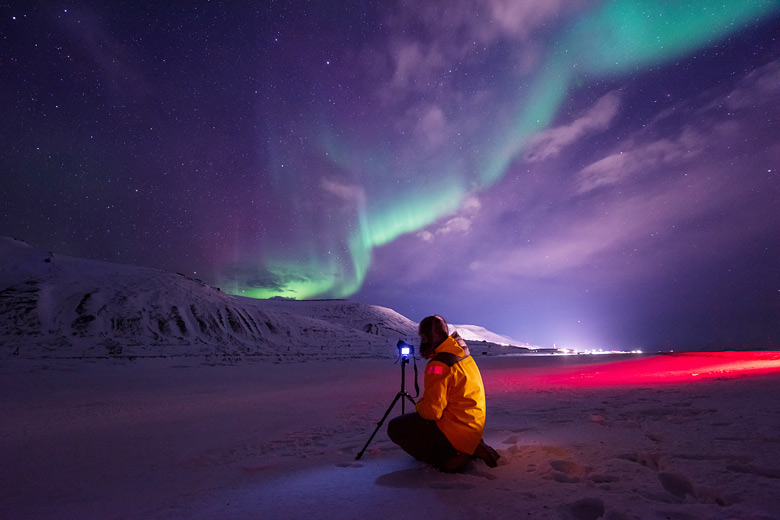
Tips for photographers
For still images, you need a camera with manual settings, so you can set the aperture and exposure time, and deactivate features like autofocus. You also need a wide-angle lens, 24mm or wider, to capture as much of the sky as possible. The faster the lens, the better; that's the maximum aperture setting. F2.8 is good, F1.4 is even better.
If exposure times are too long, the aurora can look blurred because it is moving, and stars behind it will appear as lines because of the rotation of the Earth. It's best to aim for exposure times of under five seconds, and to achieve this, you will need to increase the sensitivity of your camera by raising the ISO setting to at least 1600.
Top camera tip: make sure you have warm spare batteries as the cold can drain your camera battery very quickly.
If the results are still underexposed, try a mixture of increasing the exposure time and raising the ISO further, but be aware that the higher you go with the ISO, the more graininess in the final image. That said, some of the most realistic results are achieved using shorter exposure times, so experimenting with different settings is the key to success.
A tripod is non-negotiable owing to the long exposure times. Instead of using the auto timer on your camera, try a shutter release cable, which means you don't have to actually touch the camera body to release the shutter.
You will always need to experiment with exposure times, and it is an idea to try some night photography at home, both indoors and outdoors, to become familiar with low light situations before you travel, and to get a feel for handling your camera in the dark; using a red torch headlamp can help here, too.
Tips for using a smartphone
The same principles apply if you're taking photos with your smartphone. You still need to mount it on a tripod for stability and, as with a digital camera, you'll need to set your phone to manual and select night mode.
Then it's just a matter of increasing the ISO to 1600 or more, manually focusing to infinity and experimenting with different exposure times. Try five seconds to start with.
To record a video, don't switch the phone to 'video mode', use your phone's screen recorder in 'photo mode'. This is because in 'photo mode' you can select longer exposure times.
This allows the camera to gather more light, producing brighter images. But of course, because you are recording, say, one frame every three seconds, when you play the recording back at normal speed, the action appears sped up.
Top tips for aurora viewing
- do your research before you decide where to go
- have an understanding of how auroras are generated
- check what stage in the solar cycle the Sun is currently in
- remember that clear weather & dark skies are essential
- ensure you pick a date when the moon will not interfere with Northern Lights viewing
- consider going somewhere super scenic for epic photographs
Top tips for first-timers
Our advice for first-timer aurora seekers is to always prioritise clear weather over everything else, except, of course, packing the right gear. Always make sure you have appropriate warm clothing and footwear. You must be suitably dressed, especially if you're not used to sub-zero temperatures. Cold is one of the most common complaints of first-time aurora travellers.
Auroras will always be more impressive at the height of the solar cycle, so you may need to plan some years in advance; consider when the solar maximum is or was, and remember that auroras generally remain good for up to two years after.
That said, there are still impressive auroras to be seen outside the solar maximum period. Consider going at the equinoxes when displays are usually a little more intense for a few days due to the favourable alignment of Earth and the Sun's magnetic fields, and the weather is warmer than in mid-winter.
Keep an eye on daily and weekly forecasts of geomagnetic disturbances (KP-Index), solar wind, particle density and the IMF before you set off on your trip.
Ideally, go somewhere for at least three or four nights (up to seven, even better) and hire a car, which will give you flexibility to drive to areas with less cloud cover if need be.
The optimum time for seeing the Northern Lights is typically between 9.00 pm and 2.00 am. Auroras can appear early or late, but the most dramatic displays often happen around magnetic midnight. This is when the geomagnetic pole lies directly between your viewing position and the Sun on the other side of the Earth.
Ready for your next adventure? Search for places to go on holiday by type, season and more before checking out our complete collection of travel deals and discounts to help you get there for less in 2026/2027.
Be inspired
Get your weekly fix of holiday inspiration from some of the world's best travel writers plus save on your next trip with the latest exclusive offers
We promise not to share your details
Explore holiday destinations
- Beach holidays
- City breaks
- Family holidays
- Half term holidays
- Spring holidays
- Summer holidays
- Autumn holidays
- Winter sun holidays
- Honeymoons
- Coolcations
- Compare places
- Ski resorts
Save with latest deals & discounts
- Holiday offers
- Top travel brands
- Airlines & flights
- Discount hotels
- TUI
- Jet2holidays
- Neilson
- Marella Cruises
- Holiday Extras
- Pierre & Vacances
- Caledonian Travel
- Club Med
Airport parking
- Manchester Airport
- Stansted Airport
- Bristol Airport
- Luton Airport
- Birmingham Airport
- Edinburgh Airport
- Gatwick Airport
- Glasgow Airport
- Newcastle Airport
Airport lounges
- Manchester Airport
- Birmingham Airport
- Bristol Airport
- Edinburgh Airport
- Glasgow Airport
- Heathrow Airport
- Newcastle Airport
- Stansted Airport
- Gatwick Airport